Model collapse is a potential issue for AI models that has gained attention in the research community. It occurs when models are repeatedly trained on data generated by other models, which can lead to a reduction in data diversity and an accumulation of errors, ultimately degrading performance and accuracy. A recent paper in Nature by Shumailov et al. delves into this phenomenon, providing valuable insights into the risks and mechanisms of model collapse.
The Experiment
The authors of the study conducted experiments to cover a worst-case scenario: training models iteratively on synthetic copies of the original training data. While this scenario is not currently an issue in commercial-grade models, it serves as a thought experiment to explore the potential future where synthetic data might overwhelm real human-produced data.
Key Findings
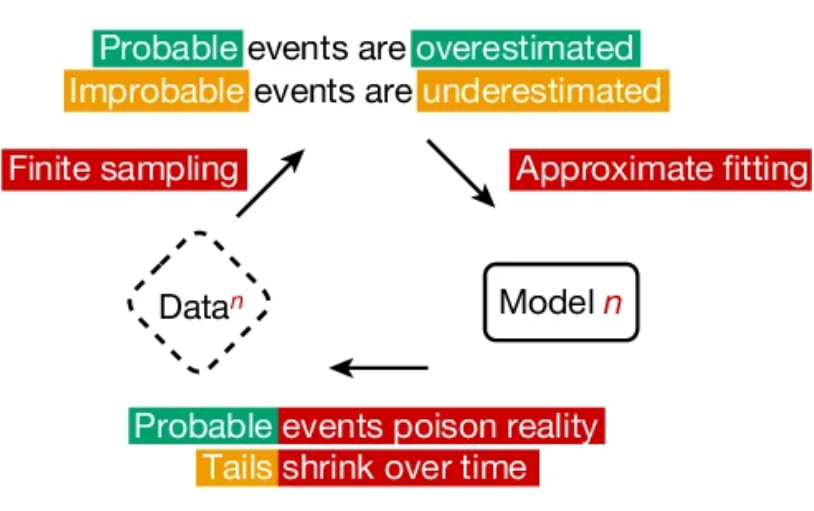
The findings of Shumailov et al. highlight a key issue: a combination of finite sampling and inappropriate fitting leads to the overestimation of probable events and the underestimation of improbable events. This imbalance can distort the model’s understanding of reality, causing it to prioritize common patterns while neglecting rarer, but potentially important, occurrences.

Mitigation Strategies
Reinforcement Learning from Human Feedback (RLHF): Guiding models with human feedback ensures that the data remains relevant and accurately reflects human perspectives. This feedback loop helps in curating the dataset and maintaining its quality over time.
Data Enrichment: Incorporating diverse and high-quality data sources helps maintain the robustness of the training dataset. By adding new human-generated data at each training stage, models can avoid the pitfalls of relying too heavily on synthetic data.
Quality Checks: Implementing rigorous quality control measures is crucial to detect and address potential issues in the data. Regular evaluation and adjustments ensure that the model does not deviate from its intended performance.
Where We Stand Today
While early generation models relied solely on human-created data, commercial-grade AI models have increasingly incorporated synthetic data. This approach has enabled the creation of larger datasets and provided engineering teams with greater control over the input data. To date, there have been no widespread effects of model collapse from this increased synthetic data use.
However, as the AI industry matures and the volume of synthetic data continues to grow, it remains to be seen whether model collapse will become more prevalent. Ongoing research and monitoring will be important in identifying and addressing these challenges to ensure the continued reliability and effectiveness of AI models.
The study by Shumailov et al. serves as an important reminder of the potential pitfalls in AI development and the need for careful management of training data.